
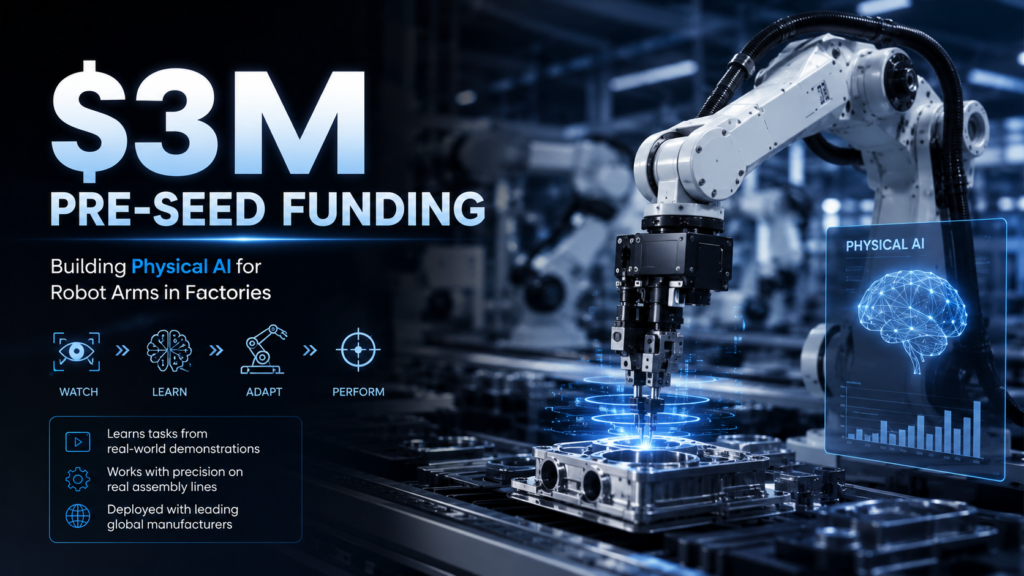
Robotics startup Mowito has raised 3 million dollars in a pre seed funding round to expand its Physical AI technology for robot arms used in factories. The announcement was shared by Puru Rastogi, who is building Physical AI models for robot arms in factories, through a LinkedIn post.
Traditional factory robots depend on rigid, hand coded programs. This means that even a small change in a part or a process can break the entire system, forcing engineers to rewrite the code again. Mowito says its Physical AI approach solves this problem in a completely different way.
Instead of relying on fixed programming, Mowito’s system learns directly by watching task demonstrations. In some cases, the robot needs to see the task performed just once before it can pick up the job on its own. The company says this allows the robots to work with the level of precision required on real assembly lines, without needing constant manual reprogramming.
According to the post, this technology is not just a research project. Mowito powered robots are already active on production lines at a Fortune 500 automotive company and at one of the world’s largest electronics manufacturers. This suggests the system has already moved beyond testing stages and is being trusted for real industrial use.
The 3 million dollar pre seed round was led by Version One Ventures. Other participants included All In Capital, Unisol, and iSeed. Several individual angel investors also joined the round, including Soumith Chintala from Thinking Machines Lab, Adarsh Kulkarni from Foundry Robotics, Ashish K Kulkarni from Coformer.ai, and Vaibhav Domkundkar from Better Capital.
The mix of institutional investors and experienced angels from the robotics and AI space signals strong industry interest in Mowito’s approach to physical automation.
With the fresh funding in place, Mowito is now shifting its focus to the United States. The company has established a presence in Detroit, a city closely tied to the automotive industry, and plans to scale its team while pushing further into the US automotive market.
Mowito’s move into physical AI reflects a growing shift in how factories may approach automation in the coming years. By allowing robots to learn tasks quickly instead of depending on rigid programming, the startup is positioning itself at the intersection of robotics and artificial intelligence, with real world deployments already backing its early growth.