Most first-time founders make the same mistake. They spend months building a full-featured product, convinced that more features mean a better product. By the time they launch, they have burned through savings, exhausted their team, and built something the market does not want. An MVP exists to prevent exactly this.
MVP stands for Minimum Viable Product. It is the simplest version of your product that delivers the core value to your target user and allows you to learn whether your assumptions about the market are correct. The key word is minimum. Not minimum in quality, but minimum in scope. You are building the least amount of product necessary to test whether your idea works in the real world.
This guide walks you through what an MVP actually is, how to think about it, and how to build one step by step regardless of whether you have a technical background or not.
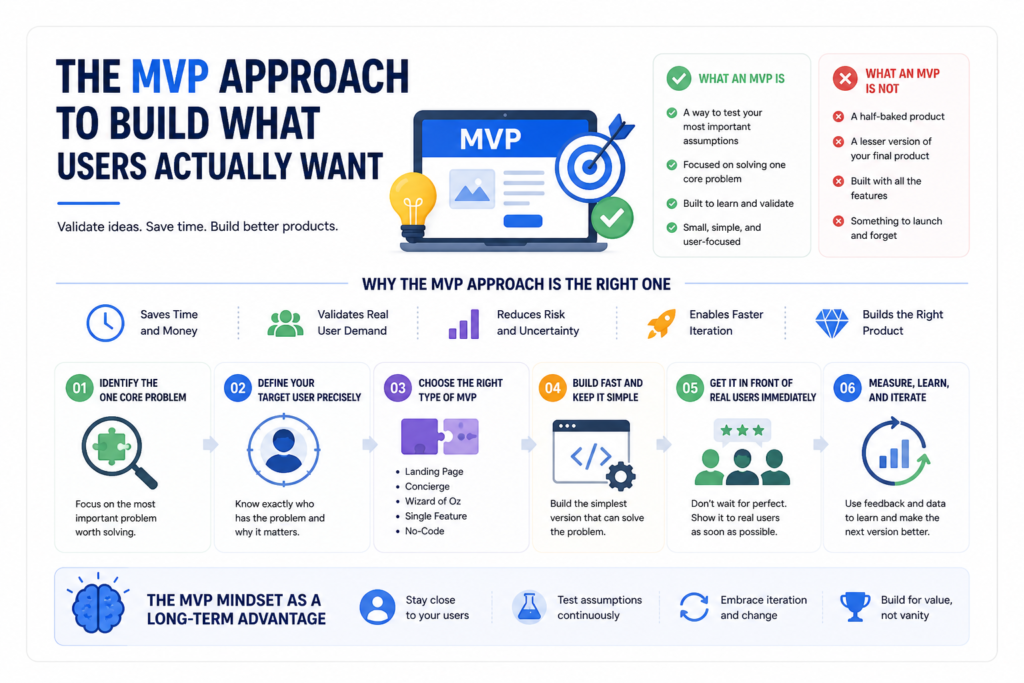
What an MVP Is and What It Is Not
An MVP is not a half-finished product with broken features and a bad user experience. It is not something you are embarrassed to show people. And it is not a prototype that only works in a controlled demo environment.
An MVP is a real product that real users can use to solve a real problem. It is stripped down to the single most important thing your product does, with everything else removed. The goal is to deliver the core value of your idea to a small group of users and observe what happens. Do they use it? Do they come back? Do they tell others about it? Do they pay for it?
Reid Hoffman, the founder of LinkedIn, famously said that if you are not embarrassed by the first version of your product, you launched too late. That captures the MVP mindset well. You are not trying to build something perfect. You are trying to build something real enough to learn from.
The MVP is also not a one-time thing. It is the starting point of a build-measure-learn cycle that continues throughout the life of your startup. You build something, measure how users respond, learn from that data, and build the next version based on what you learned. The MVP is just the first iteration of that loop.
Why Building an MVP Is the Right Approach
The startup world is full of uncertainty. You do not know for certain that your target users have the problem you think they have. You do not know if your solution is the right one. You do not know which features users will actually use versus which ones you assumed they would want. An MVP is how you replace assumptions with evidence.
Building a full product before testing your assumptions is expensive in every sense. It takes time, money, and energy. If your assumptions turn out to be wrong, you have wasted all of that. An MVP limits the cost of being wrong by letting you test early and adjust quickly.
There is also a psychological benefit. When founders spend a year building something, they become emotionally attached to it. It becomes very hard to change direction even when the evidence says they should. Founders who build MVPs and get feedback early are much more willing to pivot because they have not over-invested in a single direction.
Step 1: Identify the Core Problem Your MVP Will Solve
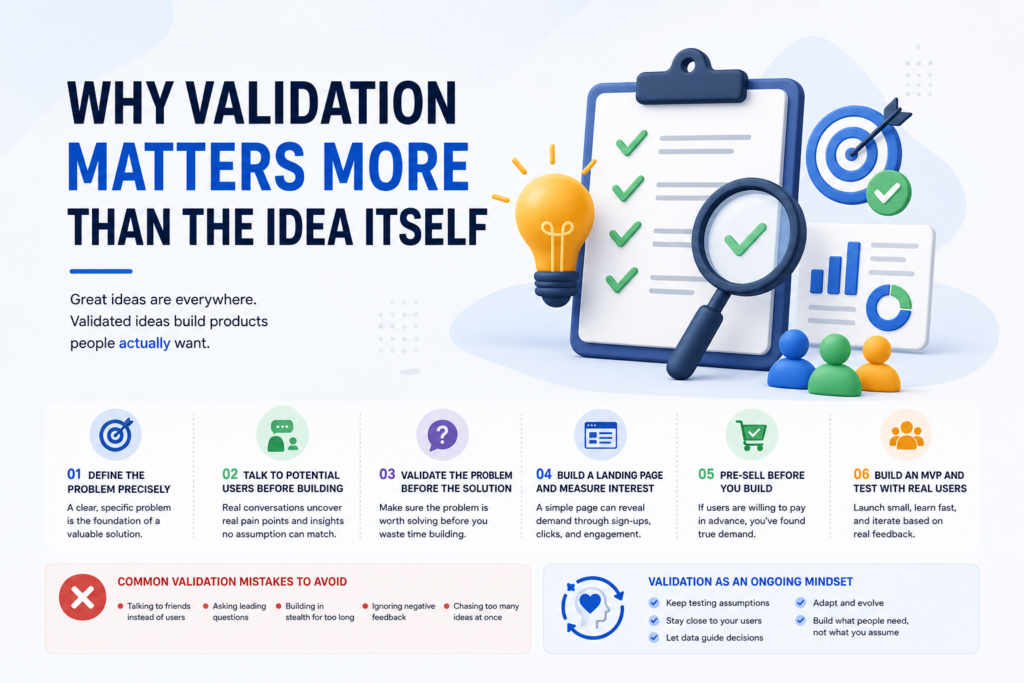
Before you build anything, you need to be ruthlessly clear about the one problem your MVP is solving. Not five problems. Not two. One.
Go back to your validation research. What is the single most painful and frequent problem your target user faces? What is the one thing your product must do for users to get value from it? That is the core of your MVP.
Everything else is a distraction at this stage. Features that are nice to have, things you plan to add later, integrations that would make the product more convenient, all of that goes on a list for future versions. The MVP has one job. Make sure it does that job well.
A useful exercise is to write down every feature you plan to build and then ask yourself, for each one, whether the product still delivers its core value without that feature. If the answer is yes, remove it from the MVP. Keep doing this until you cannot remove anything else without breaking the core value. What remains is your MVP scope.
Step 2: Define Your Target User Precisely
An MVP built for everyone is built for no one. The narrower your target user, the easier it is to build something they genuinely love rather than something that kind of works for a lot of different people.
Define your target user in specific terms. Not just “college students” but “final year engineering students in Tier 1 Indian colleges who are looking for their first job.” Not just “small business owners” but “restaurant owners in Tier 2 Indian cities who manage their inventory manually.” The more specific you are, the more focused your MVP will be, and the more likely it is to resonate deeply with the people you are building for.
Starting narrow does not mean staying narrow forever. Many of the biggest startups in the world started by serving a very specific niche and expanded from there. Zomato started in Delhi. Ola started in Bangalore. Serving a small, well-defined segment exceptionally well is far more valuable than serving a large segment adequately.
Step 3: Choose the Right Type of MVP
There is no single way to build an MVP. The right approach depends on your product, your market, and your resources. Here are the most common types of MVPs and when each one makes sense.
A landing page MVP is the simplest form. You build a page that describes your product and its value, and you ask visitors to sign up or pre-pay. You have not built anything yet. You are just measuring whether there is enough interest to justify building. This works well for any product category and is often the right first step before building anything at all.
A concierge MVP involves manually delivering the service that your product will eventually automate. Instead of building software, you do the work yourself, by hand, for a small number of users. This lets you learn exactly what users need without any technical investment. A startup building a meal planning app might start by manually creating personalized meal plans for ten users via WhatsApp before writing any code.
A wizard of oz MVP looks like an automated product from the user’s perspective but is actually powered by humans behind the scenes. Users interact with what appears to be a working product, but a person is manually handling the requests in real time. This is useful when building the actual technology would take significant time and you want to test user behavior first.
A single feature MVP is a stripped-down version of your full product vision that does exactly one thing. This is the most common type for software startups. You pick the most important feature, build it well, and ignore everything else until you have learned from real users.
A no-code MVP uses tools like Glide, Bubble, Webflow, or Notion to build a working product without writing any code. For non-technical founders in particular, no-code tools have made it possible to launch real products in days rather than months. Many Indian startups have validated entire business models using no-code tools before hiring their first engineer.
Step 4: Build It Fast and Keep It Simple
Speed is one of the most important principles of MVP development. The longer you spend building before getting user feedback, the more risk you are taking on. Build fast, ship early, and learn quickly.
This does not mean cutting corners on the core experience. If your MVP is supposed to help users do one specific thing, that one thing should work well. But everything around it, the design polish, the extra features, the onboarding flow, the analytics dashboard, can be rough. Users will forgive an imperfect product if it solves a real problem for them. They will not forgive a beautiful product that does not actually help them.
Set a deadline for your MVP. Give yourself two to six weeks depending on the complexity of what you are building. The deadline creates urgency and forces you to make hard decisions about what to cut. Without a deadline, scope creep will push your launch further and further into the future.
If you are a non-technical founder, the no-code route or a concierge MVP is almost always faster than hiring developers and waiting for them to build something. Speed of learning matters more than technical sophistication at this stage.
Step 5: Get It in Front of Real Users Immediately
The MVP is worthless until real users are using it. Do not wait until it feels ready. Do not spend weeks refining it before showing anyone. As soon as it can deliver its core value, put it in front of people.
Start with the users you spoke to during your validation research. They already know about the problem, they have shown interest in a solution, and they are the most likely to give you useful feedback. Reach out to them directly, explain that you have built an early version, and ask if they would be willing to try it.
Watch how they use it rather than just asking them what they think. People often say one thing and do another. If possible, sit with users as they use your product for the first time and observe where they get confused, what they ignore, and what delights them. That observation is more valuable than any survey or interview.
Step 6: Measure, Learn, and Iterate
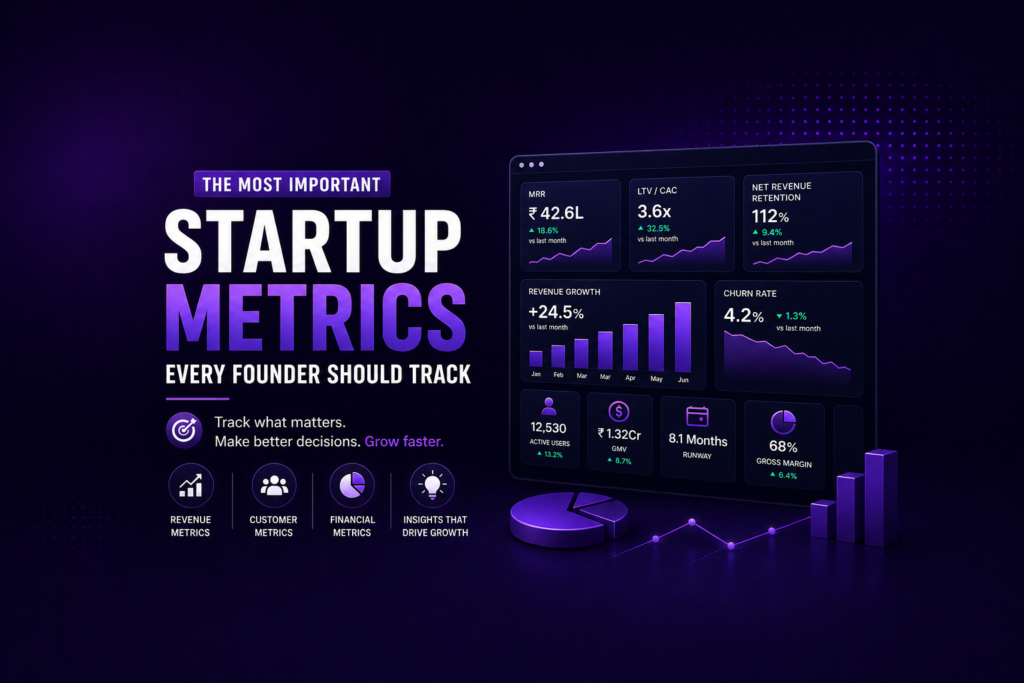
Once users are engaging with your MVP, the real work begins. Track what users actually do rather than what you expected them to do. Which features do they use most? Where do they drop off? How many come back after their first session? How many refer others?
Go back to the key metrics from your business model. If you are building a subscription product, watch activation and retention closely. If you are building a marketplace, track whether both sides of the market are engaging. If you are building a consumer app, watch daily active users and session length.
Talk to users regularly. Ask them what they love, what frustrates them, and what one thing would make the product significantly more valuable to them. The answers will tell you what to build next.
Use what you learn to decide whether to persevere, which means continuing to build in the same direction with refinements, or pivot, which means making a significant change to the product, target user, or business model based on what you have learned. Both are valid outcomes. The goal is not to be right from the beginning but to find what is right as quickly as possible.
The MVP Mindset Is a Long-Term Advantage
The discipline of building the minimum necessary, shipping it quickly, and learning from real users does not end after your first product launch. It is a way of thinking that the best startup teams carry with them at every stage of growth.
Every new feature is its own MVP. Every new market you enter is a new hypothesis to test. Every pricing change, every new user segment, every product experiment follows the same build-measure-learn logic. Founders who internalize this mindset ship faster, waste less, and build products that people actually want because they never stop treating their assumptions as things to be tested rather than things to be trusted.
Start smaller than feels comfortable. Ship sooner than feels ready. The market will tell you everything you need to know.