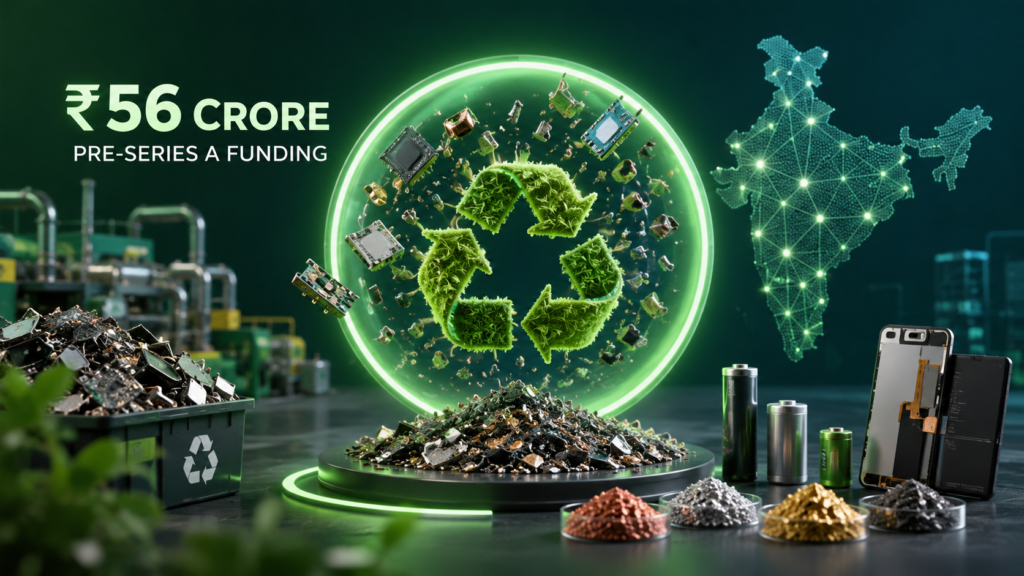
Gurugram-based circular economy startup Karo Sambhav has secured ₹56 crore in a Pre-Series A funding round from Rainmatter by Zerodha. The capital will be deployed to build out high-quality recycling infrastructure focused on recovering critical, precious, and high-value materials from e-waste and other end-of-life product streams.
Founded in 2017, Karo Sambhav spent nearly a decade scaling without external funding. Over that period, the company built two operational recycling facilities and established waste collection channels across more than 50 cities in India. It has channelised over 150,000 metric tonnes of waste toward responsible recycling. The company works across multiple material streams including e-waste, batteries, glass, and allied categories, supported by a technology platform that enables transparency and traceability across the recycling chain.
This funding marks the company’s first major institutional capital raise after years of patient, bootstrapped execution.
What the Funding Will Be Used For
The investment will primarily go toward scaling infrastructure designed to recover critical raw materials from end-of-life electronics. E-waste is the immediate priority, given the concentration of valuable metals and components it contains, including rare earths used in motors and magnets, gold, silver, platinum group metals, and copper found in printed circuit boards, as well as lithium, cobalt, nickel, and graphite used in batteries, and indium and tin present in display screens.
Karo Sambhav’s planned infrastructure has already received an Eligibility Status under the Incentive Scheme for Promotion of Critical Mineral Recycling, which falls under the National Critical Minerals Mission managed by the Ministry of Mines. This recognition positions the company well for government-aligned expansion in a sector the country considers strategically important.
India is currently the third-largest generator of e-waste in the world, producing an estimated 4.1 million metric tonnes annually. Global e-waste generation is projected to reach 82 million metric tonnes by 2030. This scale of end-of-life electronics represents both a serious environmental challenge and a significant untapped resource opportunity.
Access to critical raw materials is directly linked to India’s ability to build reliable supply chains across sectors like electronics manufacturing, clean energy, mobility, defence, healthcare, digital infrastructure, and advanced manufacturing. By recovering these materials domestically through responsible recycling, companies like Karo Sambhav reduce the country’s dependence on imported raw materials.
Pranshu Singhal, Founder and CEO of Karo Sambhav, said the company has spent nine years building the operational foundation required to collect, recycle, and trace these material streams at scale. The Rainmatter investment, he noted, now enables the next step of building high-quality infrastructure for critical raw material recovery.
Viraj Joshi, VP at Zerodha and Rainmatter, said the fund backs organisations working on long-term solutions in climate resilience, sustainability, and resource efficiency. He highlighted Karo Sambhav’s consistent execution and systems-level impact in a sector that is both difficult to operate in and critical to India’s future.
Beyond operational scale, Karo Sambhav has also built a credible reputation in the sustainability space. The company received the Social Entrepreneur of the Year India 2021 award from the Schwab Foundation for Social Entrepreneurship, a programme run under the World Economic Forum.
With institutional backing now in place for the first time, Karo Sambhav is entering a new phase focused on turning India’s growing e-waste problem into a domestic supply of critical materials needed for the country’s next generation of manufacturing and clean energy infrastructure.