Every industry has its own language, and the startup world is no different. Whether you are pitching to investors, hiring your first team, or just trying to follow what is happening in the ecosystem, not knowing these terms puts you at a disadvantage. This glossary covers the 50 most important startup terms every founder should understand, explained in plain language without unnecessary jargon.
The 50 Terms
- Startup – A newly founded company designed to grow quickly, usually by solving a specific problem with a scalable product or service. Unlike a traditional small business, a startup is built with the intention of reaching a large market fast.
- Founder – The person or people who start a company. Founders are responsible for the original idea, the early execution, and setting the culture and direction of the business.
- Co-founder – A partner who joins at the very beginning and shares ownership and responsibility in building the company. A good co-founder typically brings skills that complement the other founder’s strengths.
- Business Model – The logic of how a company makes money. It defines what is being sold, who is buying it, and how payment is structured. Common models include subscription, marketplace, SaaS, and D2C.
- Bootstrapping – Building a company using only personal savings or revenue generated by the business itself, without raising outside investment. Bootstrapped founders retain full ownership but grow more slowly.
- Equity – Ownership in a company expressed as a percentage. When founders give equity to investors or employees, those people become partial owners of the business.
- Valuation – The estimated worth of a company at a given point in time. Valuation is determined during funding rounds and affects how much equity an investor receives for their money.
- Pre-money Valuation – The value of a company before a new round of investment is added. If a startup has a pre-money valuation of 10 crores and raises 2 crores, the post-money valuation becomes 12 crores.
- Post-money Valuation – The value of a company after new investment has been added. This is the number most commonly referenced when a funding round is announced.
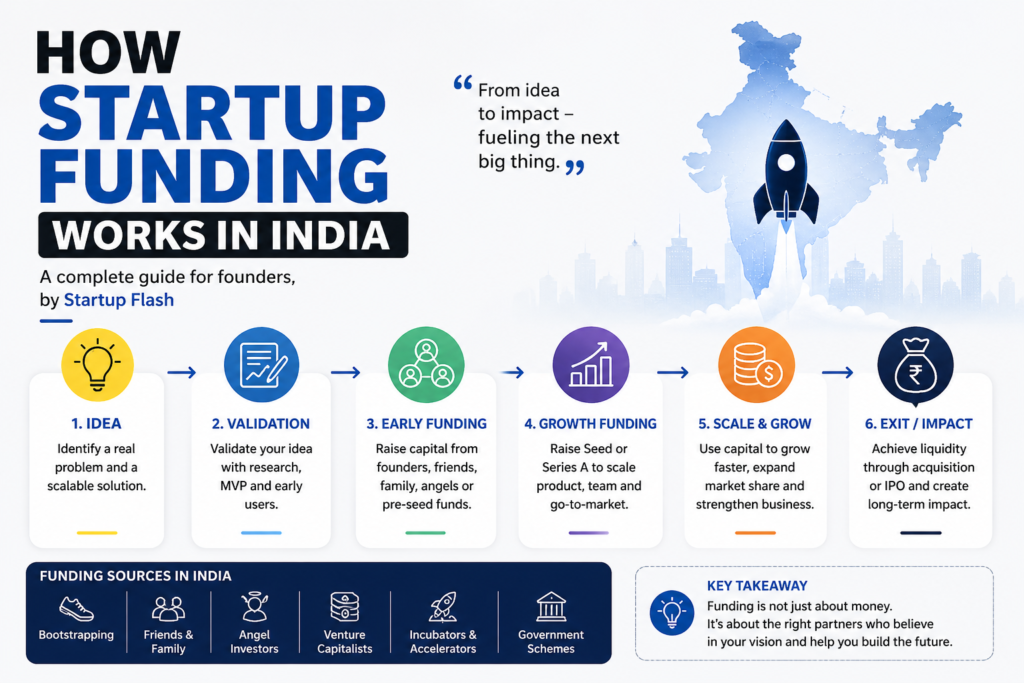
- Funding Round – A structured process in which a startup raises capital from investors. Rounds are typically labeled as pre-seed, seed, Series A, Series B, and so on, each representing a different stage of growth.
- Pre-seed – The earliest stage of funding, usually raised from founders, friends, and family. The money is used to validate the idea or build a basic prototype before formal investors come in.
- Seed Round – The first formal round of investment, typically raised from angel investors or early-stage venture funds. The startup usually has a working product or early traction at this stage.
- Series A – The first major institutional funding round, raised after a startup has proven its product works and is generating early revenue. Series A investors are betting on the team’s ability to scale.
- Series B and Beyond – Later funding rounds raised by startups that are already growing and need capital to expand faster. Each successive round typically involves larger amounts and more established investors.
- Angel Investor – A high-net-worth individual who invests their own money into early-stage startups, usually in exchange for equity. Angels often provide mentorship and introductions alongside capital.
- Venture Capital (VC) – A professional investment firm that pools money from institutions and wealthy individuals and deploys it into high-growth startups in exchange for equity. VCs typically invest across multiple stages.
- Term Sheet – A non-binding document that outlines the proposed terms of an investment, including valuation, ownership percentage, and investor rights. It is the starting point for finalizing a deal.
- Cap Table — Short for capitalization table. A document that shows who owns what percentage of a company, including founders, investors, and employees with stock options.
- Dilution – The reduction in an existing shareholder’s ownership percentage that happens when new shares are issued during a funding round. Dilution is normal and expected but needs to be managed carefully over multiple rounds.
- SAFE – Simple Agreement for Future Equity. A contract where an investor puts money into a startup now in exchange for the right to receive equity at a future funding round, usually at a discounted price.
- Convertible Note – A form of short-term debt that converts into equity at a later funding round. Similar to a SAFE but structured as a loan with interest and a maturity date.
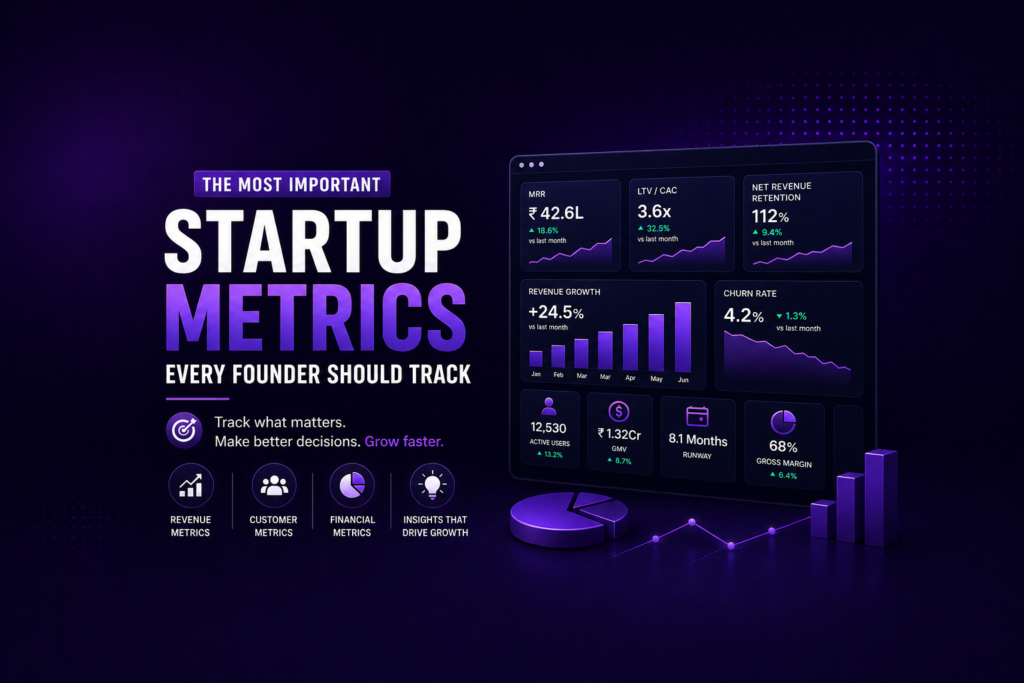
- Runway – The amount of time a startup can continue operating before it runs out of money, assuming its current rate of spending. If a startup has 50 lakhs in the bank and spends 5 lakhs per month, its runway is 10 months.
- Burn Rate – The rate at which a startup spends money each month. Gross burn is total spending. Net burn is spending minus revenue. Investors pay close attention to burn rate to understand how efficiently a company is operating.
- Revenue – The total money a company earns from selling its product or service before any expenses are deducted. Revenue is different from profit, which accounts for costs.
- ARR – Annual Recurring Revenue. The total recurring revenue a company expects to generate in a year, typically used by subscription and SaaS businesses. It is one of the most important metrics for these types of startups.
- MRR – Monthly Recurring Revenue. The recurring revenue a company generates each month. MRR multiplied by 12 gives ARR. Investors track MRR closely to understand growth trajectory.
- GMV – Gross Merchandise Value. The total value of transactions processed through a platform over a period of time. Used commonly by marketplaces, GMV measures the scale of activity on the platform, not just the revenue the company keeps.
- Unit Economics – The revenue and cost directly associated with a single unit of a business, whether that is one customer, one order, or one transaction. Good unit economics means each unit generates more value than it costs.
- CAC – Customer Acquisition Cost. The total amount a company spends on sales and marketing divided by the number of new customers acquired in that period. Keeping CAC low relative to customer value is critical for sustainable growth.
- LTV – Lifetime Value. The total revenue a company expects to earn from a single customer over the entire duration of their relationship. A healthy business has an LTV that is significantly higher than its CAC.
- Churn – The percentage of customers who stop using a product or cancel their subscription within a given period. High churn is a red flag because it means the business is losing value faster than it is creating it.
- Product Market Fit – The point at which a startup’s product satisfies a strong market demand. Founders often describe achieving product market fit as the moment when growth starts happening organically and customers are genuinely upset at the idea of losing the product.
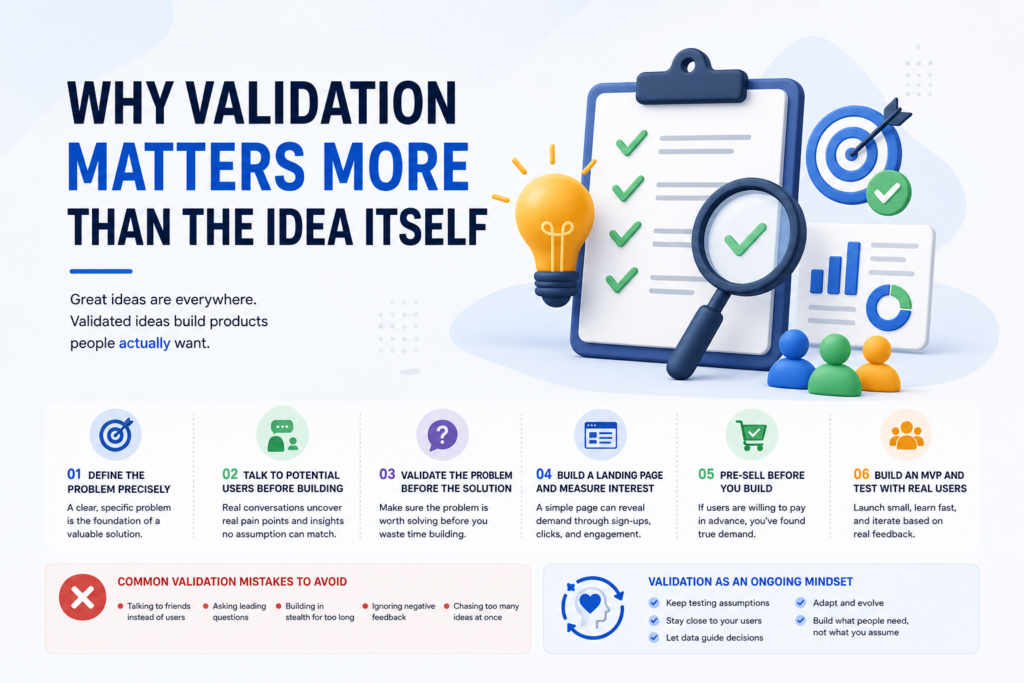
- MVP – Minimum Viable Product. The simplest version of a product that can be released to real users to test a core assumption. An MVP is not a finished product but a learning tool designed to get feedback quickly with minimal investment.
- Pivot – A significant change in a startup’s product, target market, or business model based on learning from the market. Pivoting is not failure; it is course correction. Many successful startups, including Instagram and Slack, pivoted from their original ideas.
- Traction – Evidence that a startup’s product is working and that the market wants it. Traction can be measured in users, revenue, engagement, partnerships, or any other metric that demonstrates real-world validation.
- Scalability – The ability of a business to grow its revenue significantly without a proportional increase in costs. A scalable business can serve 10 times more customers without needing 10 times more resources.
- Network Effect – A phenomenon where a product becomes more valuable as more people use it. Social networks, marketplaces, and payment platforms all benefit from network effects because each new user adds value for every existing user.
- Moat – A sustainable competitive advantage that makes it difficult for competitors to replicate what a company has built. Moats can come from network effects, proprietary technology, brand, switching costs, or regulatory advantages.
- Due Diligence – The process investors go through before finalizing an investment, involving a thorough review of the startup’s financials, legal documents, product, team, and market claims. It is the investor’s way of verifying what the founder has presented.
- Lead Investor – The primary investor in a funding round who sets the terms, contributes the largest portion of capital, and often takes a board seat. Other investors follow the lead investor’s term sheet.
- Board of Directors – A group of people elected to oversee the management of a company. As startups raise institutional money, investors typically take board seats, giving them formal influence over major company decisions.
- Vesting – A schedule that determines when founders or employees actually earn their equity over time. A typical vesting schedule is four years with a one-year cliff, meaning no equity is earned until the first year is complete, after which it vests gradually.
- Cliff – The minimum period an employee or founder must work before any of their equity vests. A one-year cliff means if someone leaves before completing one year, they receive no equity at all.
- ESOP – Employee Stock Option Pool. A portion of a company’s equity set aside to give employees the option to buy shares at a fixed price in the future. ESOPs are used to attract and retain talent when a startup cannot compete on salary alone.
- Incubator – A program that supports very early-stage startups with workspace, mentorship, and sometimes small amounts of funding. Incubators typically work with startups that are still developing their idea or early product.
- Accelerator – A time-bound program, usually three to six months, that helps startups grow quickly through intensive mentorship, resources, and often a small investment. Y Combinator and Antler are well-known examples.
- Unicorn – A private startup that has reached a valuation of one billion dollars or more. The term was coined because such companies were once considered rare. India now has over 100 unicorns.
- Decacorn – A private startup valued at ten billion dollars or more. A step above unicorn, this term applies to a very small number of companies globally. Byju’s and Flipkart have reached decacorn status.
- Exit – The way an investor or founder ultimately converts their equity into cash. Common exit routes include an IPO, where the company lists on a stock exchange, or an acquisition, where a larger company buys the startup.
- IPO – Initial Public Offering. The process by which a private company offers its shares to the public on a stock exchange for the first time. An IPO is often seen as a milestone of success and provides liquidity to early investors and founders.
These 50 terms form the core vocabulary of the startup world. You do not need to memorize all of them at once, but the more fluent you become in this language, the more confidently you can operate as a founder, whether you are in a room with investors, recruiting your first hire, or simply trying to understand what is happening in the ecosystem around you.