Starting a company takes more than just a good idea. It takes money. And for most founders in India, figuring out where that money comes from is one of the first real challenges they face. Whether you are a student with a business idea or someone who just started following the startup world, understanding how startup funding works is the foundation of everything else.
India is now the third-largest startup ecosystem in the world. Thousands of startups get funded every year, across industries ranging from fintech and edtech to healthtech and deeptech. But behind every funding announcement you read about is a process that most people do not fully understand. This guide breaks it all down in plain language.
What Is Startup Funding?
Startup funding is money that a company raises from outside sources to build or grow its business. Instead of using their own savings or taking a bank loan, founders raise capital from investors who believe in the potential of the business.
In exchange for this money, investors typically receive equity, which means they get a small ownership stake in the company. If the company grows and eventually gets acquired or goes public, those investors make a return on what they put in. If the company fails, they lose their investment. This risk-reward dynamic is at the core of how startup investing works.
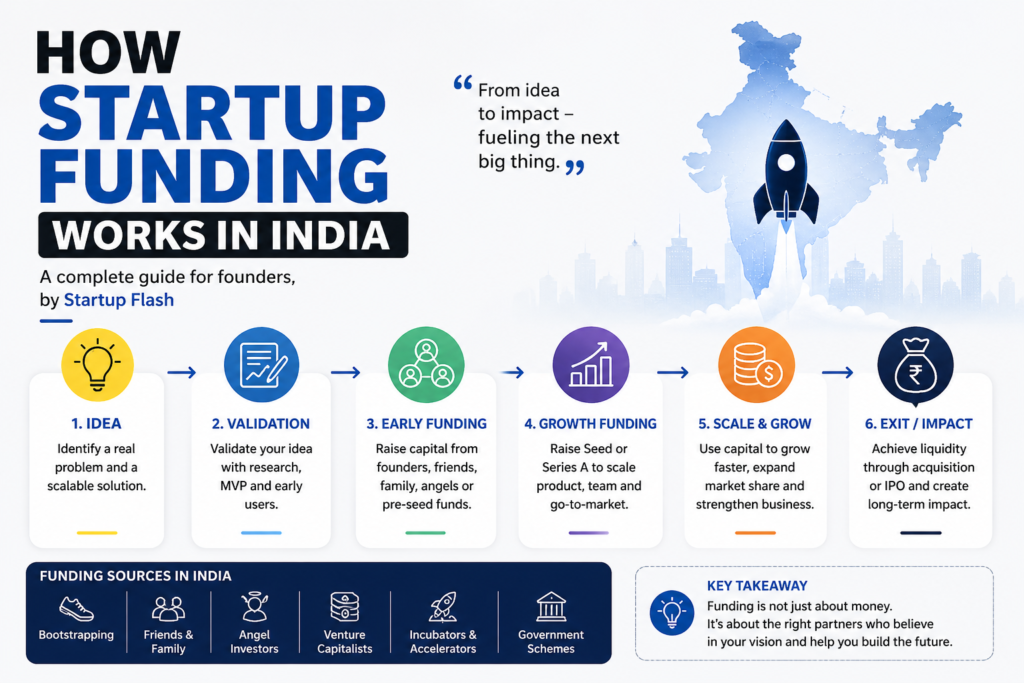
Not every startup needs external funding. Some businesses are built entirely on revenue, which is called bootstrapping. But startups that are trying to grow fast, build technology, or capture a large market quickly often need capital to move faster than revenue alone would allow.
The Different Stages of Startup Funding
Startup funding does not happen all at once. It comes in rounds, and each round corresponds to a different stage in a company’s life. Understanding these stages is important because the type of investor, the amount of money, and what the money is used for all vary significantly from one stage to the next.
The first stage is called pre-seed funding. This is the earliest money a startup raises, usually from the founders themselves, their families, or close friends. At this point, the startup might just be an idea or a very early prototype. The amounts are small, often ranging from a few lakhs to a couple of crores, and the goal is simply to get started.
After pre-seed comes seed funding. This is where formal investors start getting involved. Seed rounds in India typically range from a few crores to around 10 to 15 crores. At this stage, the startup usually has a working product or at least a clear plan, and it is trying to find its first real users or customers. Angel investors and early-stage venture capital funds are the most common sources of seed funding in India.
Once a startup has proven that its product works and that people are willing to pay for it, it moves into Series A. This is where the real scaling begins. A Series A round in India today can range anywhere from 20 crores to over 100 crores. Investors at this stage want to see a clear business model, strong early growth, and a team that can execute. The money is used to hire, expand to new markets, and build out the product further.
Series B and Series C rounds come after that. These are raised by startups that are already doing well and want to grow much faster. The amounts get significantly larger, often running into hundreds of crores or even thousands of crores for companies at the Series C stage and beyond. At these stages, large venture capital firms, private equity funds, and sometimes sovereign wealth funds get involved.
Beyond Series C, some startups continue raising money at later stages before eventually going public through an IPO, or getting acquired by a larger company. Companies that reach a private valuation of 1 billion dollars or more are called unicorns. India now has over 100 unicorns, including names like Zepto, Razorpay, CRED, and Meesho.
Who Are the Investors?
Different types of investors participate at different stages of a startup’s journey.
Angel investors are individuals, often successful entrepreneurs or professionals, who invest their own money into early-stage startups. They are usually the first outside investors a startup will ever deal with. In India, well-known angel investors include people like Ratan Tata, who has backed startups like Ola, Paytm, and Lenskart. Angel networks like Indian Angel Network and LetsVenture make it easier for founders to connect with multiple angels at once.
Venture capital firms, or VCs, are professional investment firms that manage money pooled from institutions and wealthy individuals. They invest in startups across different stages and take a seat on the board in exchange for their investment. Some of the most active VC firms in India include Sequoia Capital India (now known as Peak XV Partners), Accel, Lightspeed India, and Blume Ventures. These firms manage hundreds or even thousands of crores and deploy capital across many startups, knowing that only a few will generate the returns that make the entire fund profitable.
Accelerators and incubators are programs that support very early-stage startups with a mix of funding, mentorship, and resources. In India, programs like Y Combinator (which accepts Indian startups), Antler India, and government-backed incubators at IITs and IIMs have helped launch hundreds of companies. The amounts involved are usually small, but the mentorship and network access can be extremely valuable.
The government also plays a role in startup funding through schemes like the Startup India Seed Fund, which provides early-stage capital to startups that meet certain criteria. Funds like SIDBI Venture Capital and grants from BIRAC for biotech startups are other examples of government-backed capital that Indian founders can access.
How Does the Funding Process Work?
Raising money is not as simple as sending an email to a VC. It is a structured process that can take months and requires preparation.
It usually starts with a pitch deck, which is a short presentation that explains what the startup does, what problem it solves, who the target customer is, how it makes money, how big the market is, and what the team looks like. A good pitch deck is concise, visually clear, and tells a compelling story.
Founders then identify investors who are relevant to their stage and sector and reach out to them, ideally through a warm introduction from someone in the investor’s network. Cold outreach works sometimes, but a referral from a trusted contact significantly improves the chances of getting a meeting.
If an investor is interested after an initial meeting, they will ask for more information and conduct due diligence, which means they verify the claims the founder has made, review financials and legal documents, and speak to customers or other references. If everything checks out, they issue a term sheet, which is a document outlining the key terms of the investment. After the term sheet is agreed upon, lawyers finalize the paperwork and the money is transferred.
The entire process from first conversation to money in the bank can take anywhere from a few weeks to several months, depending on the investor and the complexity of the deal.
Key Terms Every Beginner Should Know
Startup funding comes with its own vocabulary, and not knowing these terms can make conversations and news articles difficult to follow.
Valuation is what the company is estimated to be worth at the time of funding. A pre-money valuation is the value before the new investment comes in, and a post-money valuation includes the new capital.
Equity is ownership in the company, expressed as a percentage. When an investor puts in money, the founders give up a portion of their equity in return.
Dilution happens when new shares are issued during a funding round, which reduces the ownership percentage of existing shareholders, including the founders.
A term sheet is the document that outlines the proposed terms of an investment. It is not legally binding in most cases, but it sets the framework for the final deal.
A cap table, short for capitalization table, is a document that shows who owns what percentage of the company at any given time.
SAFE stands for Simple Agreement for Future Equity. It is a common instrument used in early-stage funding where an investor puts in money now in exchange for the right to receive equity in a future funding round at a discounted price.
Why This Matters Even If You Are Not a Founder
Understanding startup funding is useful even if you are not planning to start a company anytime soon. If you follow the startup ecosystem, reading funding news becomes much more meaningful when you know what a Series B actually implies about a company’s stage and maturity. If you are considering joining a startup, understanding equity and dilution helps you evaluate whether the stock options you are being offered are worth anything. If you are interested in investing yourself someday, understanding how venture capital works is the starting point.
India’s startup ecosystem is only going to keep growing. More capital is flowing into Indian startups than ever before, more funds are being set up specifically for India, and more founders from smaller cities and non-metro colleges are breaking through. Knowing how the funding world works puts you ahead of most people your age, regardless of what you end up doing with that knowledge.